

Blog, Wall Decorating Ideas
Creative Outdoor Metal Wall Art Ideas
Powder-coated steel wall art works in any outdoor spot that gets regular weather — fences, garden walls, patios, entryways, and poolside. The placement rules are simple: contrast matters more than size, and the right mounting gap prevents moisture damage behind the piece.
Tricia. C
Most outdoor decor fails for one of two reasons: wrong material for the exposure level, or poor placement that makes the piece disappear against its background. This guide fixes both. You’ll find seven placement spots that work well for metal art, with specific size recommendations, background tips, and mounting notes for each one.
Contents
Which Outdoor Metal Art Works Where — Quick Reference
Before diving into each placement, use this table to match the spot to the right piece type and size.
| Placement spot | Best piece type | Recommended size | Key consideration |
| Garden wall or fence | Steel cutout or sculptural piece | 24–48 inches wide | Contrast with wall colour |
| Above patio furniture | Decorative panel or custom sign | Two-thirds of furniture width | Mount 6–8 inches above furniture top |
| Entryway or front gate | Custom name/address sign | 18–30 inches | Readable from 10–15 feet away |
| Against hedges or plants | Steel cutout with open design | 18–36 inches | Mount 2 inches from foliage |
| Garden shed or outbuilding | Decorative sign or themed cutout | 24–36 inches | Paint shed to contrast the piece |
| Near pool or water feature | Water-themed panel or custom sign | 24–36 inches | Choose aluminium over bare steel |
| Hidden garden corner | Small sculptural piece or quote sign | 12–24 inches | Add a ground spotlight for night effect |
1. Garden Walls and Fences
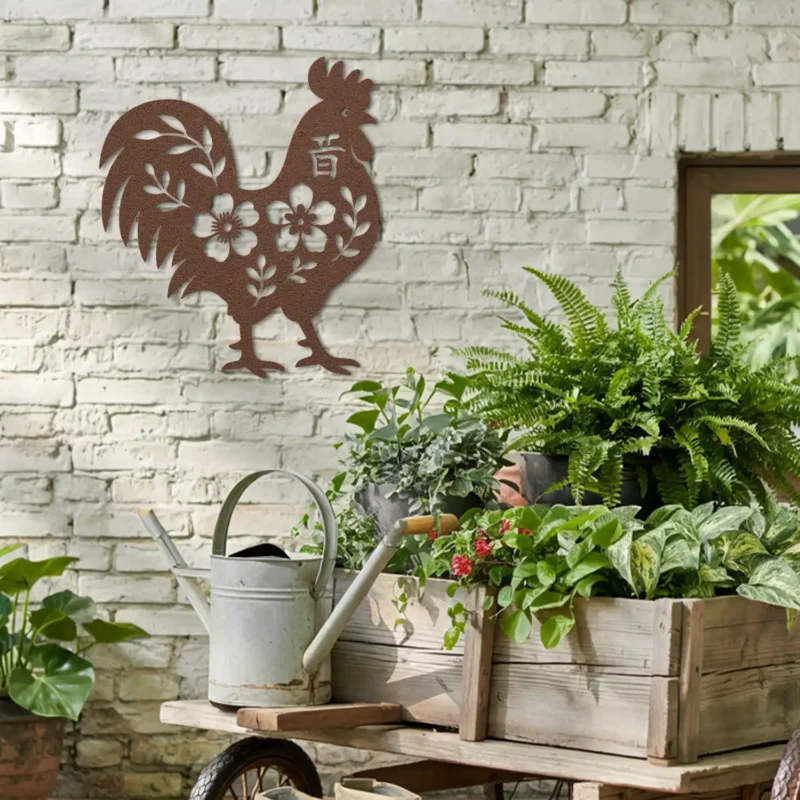
A fence or garden wall is your best outdoor canvas — large surface, visible from multiple angles, and usually a single background colour that’s easy to contrast against.
The main mistake here is choosing a piece that blends in. Dark powder-coated steel disappears against a dark fence. A brushed or lighter-finish piece against the same fence reads immediately.
Size rule: On a fence panel, the art should span no more than two-thirds of the panel‘s width. On a full garden wall, treat it like a living room sofa rule — art between one-third and two-thirds of the total wall width creates the right visual weight.
Mounting: Use galvanised or stainless steel screws to avoid rust staining on surrounding surfaces. Mount the piece with a 1–2 inch standoff from the wall surface so water doesn’t pool behind it. Most Bruzzen steel cutouts come with pre-drilled mounting holes that create this gap naturally.
What works here: Bold geometric cutouts, floral or botanical designs, and oversized sculptural pieces. Painted feature walls in a single neutral tone make the strongest backdrop.
2. Above Outdoor Furniture
Hanging art above your outdoor seating or dining area does the same job as indoor art — it defines the space and gives it a finished look. Without it, even good patio furniture looks unanchored.
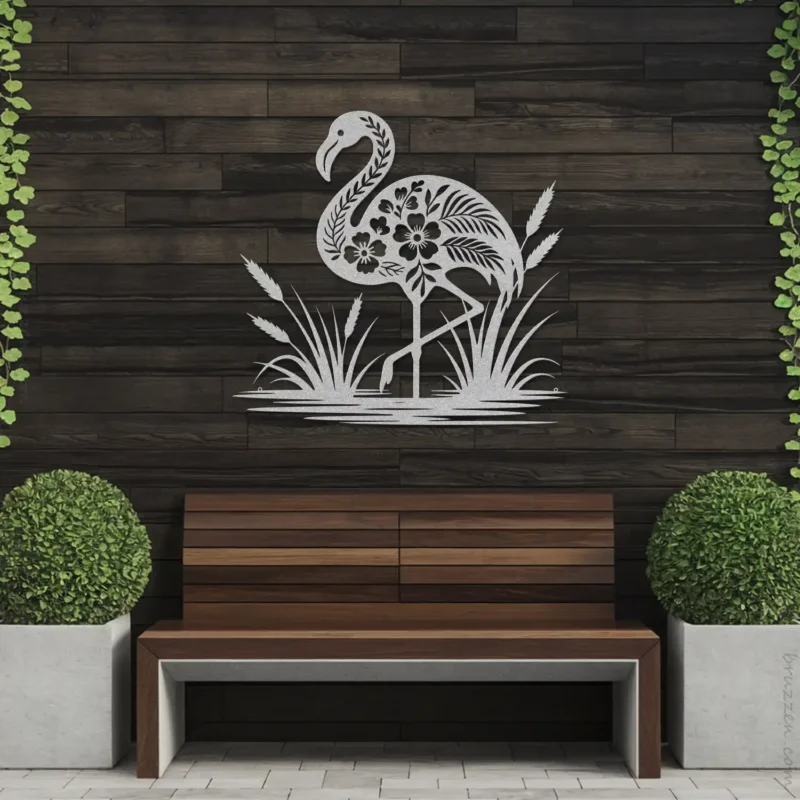
Size rule: The art should be roughly two-thirds the width of the furniture below it. For a 72-inch outdoor sofa, that means 48 inches of art width. For a 48-inch dining table, aim for 30–36 inches.
Height: Mount the piece so its bottom edge sits 6–8 inches above the top of the furniture. This mirrors the indoor hanging convention and feels proportionally right at eye level when seated.
What works here: Horizontal panels and wide decorative cutouts suit dining areas well. Abstract or nature-inspired pieces — botanicals, coastal themes, geometric forms — work across most patio styles without clashing with cushion patterns.
One thing to avoid: Pieces with fine engraved detail get lost above furniture at viewing distance. Save intricate designs for spots where people will stand close.
3. Entryways, Gates, and Pathways
Art at your garden entrance serves two jobs: it tells visitors they’ve arrived somewhere intentional, and it sets the tone for the space beyond.
Custom metal signs do this especially well. A family name plaque, an address marker, or a house number sign adds both function and personality — and unlike a painted sign, powder-coated metal holds its finish outdoors for years without fading or peeling.
Readability rule: Address numbers or name signs need to be legible from 10–15 feet away. As a baseline, 4-inch lettering reads clearly at 10 feet. For a sign mounted at street level viewed from a car, go larger — 6-inch minimum.
Along pathways: Smaller directional or decorative pieces placed at 2–3 key turning points guide visitors through the garden without signage that feels utilitarian. Scale these down — 12 to 18 inches — since people pass close and view them at arm’s length.
What works here: Custom metal name signs, monogram pieces, botanical cutouts that echo the planting around the entrance.
4. Against Plants, Hedges, and Living Walls
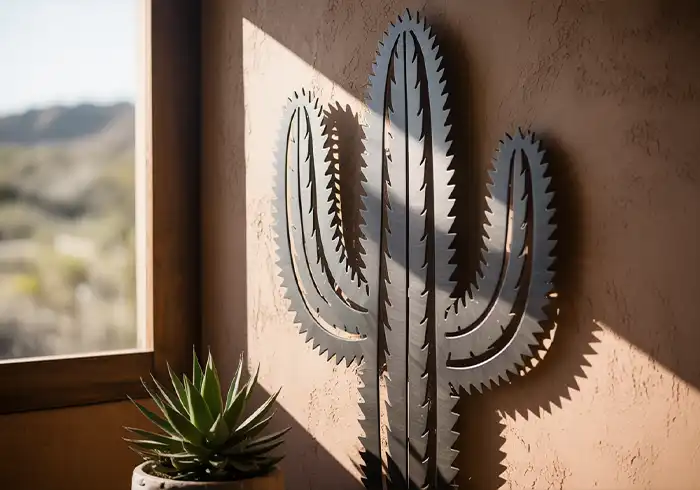
Metal art reads differently against greenery than it does against a hard wall. The contrast between rigid metal and soft organic shapes is genuinely striking — and it changes across the seasons as the planting fills in or drops back.
The main challenge is air circulation. Art mounted flush against dense hedging or climbing plants traps moisture behind the piece. Even powder-coated steel benefits from airflow.
Mounting gap: Leave at least 2 inches of clearance between the back of the piece and the nearest foliage. Use longer standoff screws if mounting into a fence behind a hedge.
Design choice: Open cutout designs — silhouettes with negative space, botanical forms, geometric lattice patterns — work best against greenery because the plants show through the gaps and become part of the composition. Solid panels compete with the texture behind them.
Size: 18–36 inches suits most garden planting contexts. Larger pieces can overpower naturalistic planting; smaller pieces disappear inside it.
5. Sheds, Garages, and Outbuildings
A utility building is one of the most overlooked outdoor surfaces. It’s usually the largest blank wall in a garden — and because it’s clearly functional, any art placed on it reads as a deliberate, confident design choice.
Themed or humorous signs work well here. Workshop signs, garden shed plaques, or playful labels (“The Greenhouse,” “Pool House,” “Dad’s Workshop”) add character without pretending the building is something it’s not.
Colour tip: If your shed is a dark neutral — dark green, charcoal, deep navy — a lighter finish or raw brushed metal piece will stand out sharply. If the shed is pale or natural timber, black powder-coated steel gives clean contrast.
Size: A 24–36 inch piece suits most single-door shed walls. For a double-door garage face, you can scale up to 48 inches without it looking undersized.
What works here: Decorative signs, botanical or nature-themed cutouts, and custom pieces that name the building’s purpose. Browse Bruzzen’s custom metal sign options if you want something specific to the space.
6. Near Pools and Water Features
Water and metal interact visually in a way that’s hard to replicate with any other material. Sunlight hitting a metal surface near water creates movement and shimmer — the piece changes through the day as the reflection shifts.
The material choice matters more here than anywhere else in the garden. Standing water, splash zones, and high-humidity air around pools accelerate surface degradation on anything with unsealed edges or raw metal.
Material rule: Choose aluminium or powder-coated steel specifically rated for outdoor use. Avoid any piece described only as “suitable for outdoor display” without a finish specification. Bare or raw metal, Corten steel, and unsealed welded pieces are not appropriate for poolside placement.
What works here: Water-themed panels — waves, sea life, coastal motifs — suit the context without being literal. Abstract geometric pieces in blue-grey or silver tones also read well near water. Custom pool rules signs in metal are a practical option: they handle the humidity, stay legible, and look considerably better than laminated paper signs.
Distance: Keep metal art at least 3 feet from any direct splash zone. Poolside walls and fence sections set back from the water’s edge are ideal.
7. Hidden Corners and Discover Moments
Not every piece needs to be immediately visible. Some of the most effective outdoor art creates what garden designers call a “discover moment” — you turn a corner or follow a path and find something unexpected.
This works because the surprise is part of the experience. A quote sign tucked behind a large shrub. A sculptural bird piece at the end of a winding path. A small geometric form mounted low on a shaded wall. These aren’t for showing off — they’re for the person who takes their time walking through the garden.
Scale down: Hidden pieces work best at 12–24 inches. Larger pieces announce themselves before they’re meant to be found.
Lighting: A small ground-level spotlight or a solar garden light aimed at the piece transforms it after dark. The shadow it casts on the wall behind it becomes a second piece of art.
What works here: Small botanical cutouts, typographic quote signs, abstract forms, or anything with fine detail that rewards close inspection. Custom pieces — a meaningful date, a family word, a specific motif — suit this placement best because the discovery feels personal.
How to Mount Outdoor Metal Art — Step by Step
- Choose the mounting surface. Masonry walls need masonry anchors. Timber fences take wood screws. Metal fences need self-tapping screws or bolted standoffs.
- Mark the position. Use a level and pencil to mark both mounting points. For a single central hole, use a spirit level against the wall to confirm it’s straight before drilling.
- Drill pilot holes. Use the correct bit for the surface — masonry bit for brick or concrete, wood bit for timber. Go 1/4 inch deeper than the anchor length.
- Insert anchors or standoffs. Tap wall anchors flush with the surface. For standoffs, thread the spacer onto the screw before driving it in — this creates the gap that keeps moisture from pooling behind the piece.
- Hang and check. Hang the piece, then step back 8–10 feet to check the level visually. What looks straight up close sometimes reads slightly off at viewing distance.
- Use stainless or galvanised fixings. Standard steel screws rust and stain the surrounding wall. Stainless steel or hot-dip galvanised fixings won’t.
For a full guide covering wall types and hook options, see how to hang metal wall art.
Common Placement Mistakes to Avoid
- ❌ Hanging art that blends into the background — dark metal on a dark wall disappears. Check the contrast before buying. Hold a dark piece of card against your wall to test.
- ❌ Undersizing for the wall — a 12-inch piece on a 10-foot fence panel looks lost. When in doubt, go larger. A piece slightly too big reads as bold; a piece too small reads as an afterthought.
- ❌ Mounting flush to the surface — no gap behind the piece traps moisture and accelerates corrosion on the wall behind it, even with powder-coated metal. Always use standoffs.
- ❌ Ignoring night visibility — most gardens are used in the evening. A piece with no lighting disappears after dark. One small ground spotlight changes this entirely.
- ❌ Using the wrong finish near water — not all “outdoor” metal art handles poolside humidity. Confirm the finish spec before buying for splash-adjacent placement.
Bruzzen Outdoor Metal Collections
These are the collections most relevant to the placement spots above.
- Outdoor metal wall art — steel cutouts and decorative panels built for full outdoor exposure, in designs ranging from botanical to geometric to coastal.
- Custom metal signs — made to your exact dimensions, text, and finish. Free digital mockup before production. Suits entryways, sheds, poolside, and discover-moment placements.
- Steel cutouts — open-design pieces that work especially well against greenery and living walls.
- Aluminium metal prints — for covered outdoor areas where you want photographic detail and vivid colour rather than a sculptural form.
Frequently Asked Questions
Can metal wall art stay outside all year?
Powder-coated steel and aluminium can stay outside permanently, including through rain, frost and direct sun. Powder coat bonds to the metal surface at high heat and resists rust, UV fade and moisture. Bare or unsealed metal, raw welded steel and pieces labelled only as weather-resistant without a finish spec should be stored or covered in harsh winters.
What size outdoor metal art do I need for a fence?
For a standard fence panel, 6 feet wide, a piece between 24 and 48 inches reads well without overwhelming the panel. For a full garden wall, aim for art that is one-third to two-thirds of the total wall width — the same rule used for indoor wall art above furniture.
How far from the wall should I mount outdoor metal art?
Mount it at least 1–2 inches from the wall surface using standoff screws or spacers. This gap lets air circulate behind the piece and prevents moisture from pooling between the metal and the wall, which can cause staining and, over time, damage to both surfaces.
What’s the best background colour for outdoor metal art?
The background should contrast the metal finish. Black or dark powder-coated steel reads best against light walls, pale fences or dense green foliage. Brushed or lighter-finish pieces suit darker backgrounds. Avoid placing metal art against textured or patterned surfaces because the background competes with the piece.
Will metal art rust outside?
Powder-coated metal will not rust under normal outdoor conditions because the coating seals the metal surface from moisture. If the coating gets scratched and raw metal is exposed, touch it up promptly with matching spray paint to prevent surface rust from starting. Aluminium does not rust at all; it may develop a light oxidation layer over time that does not affect the finish.
Can I use metal wall art near a pool?
Yes, with the right material. Choose aluminium or powder-coated steel rated for outdoor use. Keep the piece at least 3 feet from the direct splash zone. Avoid bare or Corten steel poolside because the exposed metal oxidises quickly in high-humidity environments.
Do you offer custom outdoor metal signs?
Yes. Bruzzen’s custom metal sign service produces pieces to your exact dimensions, text, finish and colour. A free digital mockup is provided before production begins. Custom pieces are available in powder-coated steel for full outdoor exposure.
→ Start your custom outdoor metal sign
Ready to Choose Your Spot?
Outdoor metal art is one of the few decor decisions where placement matters as much as the piece itself. Get the background contrast right, mount it with the correct gap, and size it to the surface — and almost any spot in your garden becomes a better version of itself.
👉 Browse outdoor metal wall art — powder-coated steel pieces for fences, patios, and garden walls 👉 Design a custom piece — name signs, address plates, and bespoke cutouts with a free mockup
Related reading:
- Benefits of Metal Wall Art for Inside and Outside
- How to Hang Metal Wall Art With or Without Nails
- Metal vs Canvas Prints: Which Is Right for Your Space?
- Acrylic vs Metal Prints: A Full Comparison
Want more wall art ideas, room styling tips and first access to new Bruzzen collections? Join the list — free.
Subscribe Free →