

Sizing, Wall Art Tips & Advice
Wall Art Size Guide & Calculator: Chart(CM/Inches)
Picking the right wall art size doesn’t have to involve guesswork. This guide breaks the process down into one simple ratio you can apply to any wall in your home — plus a free calculator, full size charts in inches and centimetres, and room-by-room placement tips to help you get it right the first time.
Measure the furniture or wall width, then multiply by 0.6 and 0.75. That range — 60 to 75% of the width — is your art size. An 84-inch sofa needs art 50 to 63 inches wide. Use the calculator below to skip the math and see the closest ready-to-order size.
Wall Art Size Calculator: Find your perfect Fit
Enter one measurement. Get your exact size range — and the closest ready-to-order Bruzzen size.
Your ideal art width
50–63 in
Closest Bruzzen sizes
Need an exact custom size? Design a custom piece →
Why the 60–75% Rule Works
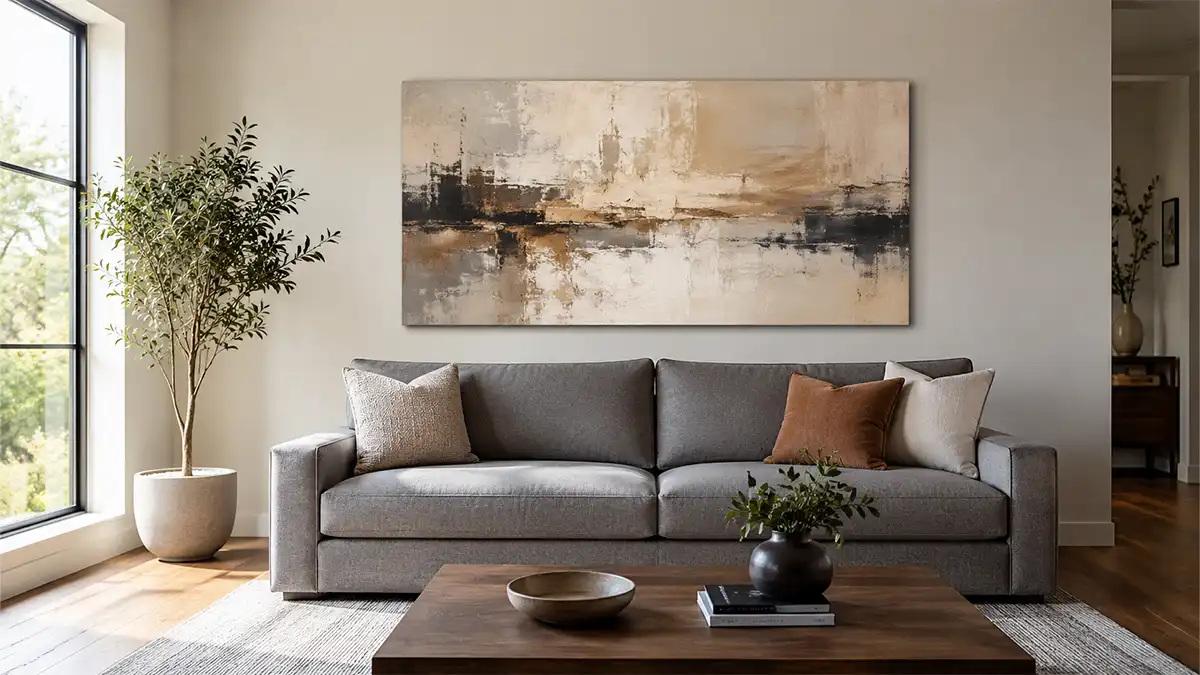
This is not a decorating opinion — it is a visual balance principle used across gallery curation and interior design. Art smaller than 50% of the furniture width reads as lost. Art covering more than 80% of the wall starts to overwhelm it. The 60-75% range is the proven middle ground that reads as intentional, regardless of room size or style.
The rule scales. It works the same way whether the sofa is 60 inches or 120 inches, whether the wall is in a small apartment or a large open-plan living room. The calculator above applies this exact formula — the manual version below shows the maths if you want to do it by hand or check the result.
Doing the Maths by Hand
Step 1: Measure the width of the furniture or wall space in inches or centimetres.
Step 2: Multiply by 0.6 to get the minimum width. Multiply by 0.75 to get the maximum width.
Step 3: Measure the height of the space. Leave 6 to 12 inches above furniture and 6 to 8 inches below the ceiling. Centre the piece at 57 to 60 inches from the floor.
Worked example: an 84-inch sofa. 84 × 0.6 = 50.4 inches minimum. 84 × 0.75 = 63 inches maximum. Target range: 50 to 63 inches wide.
This is the foundation of every wall art size calculator — the calculator above just does the arithmetic and matches the result to an actual product size.
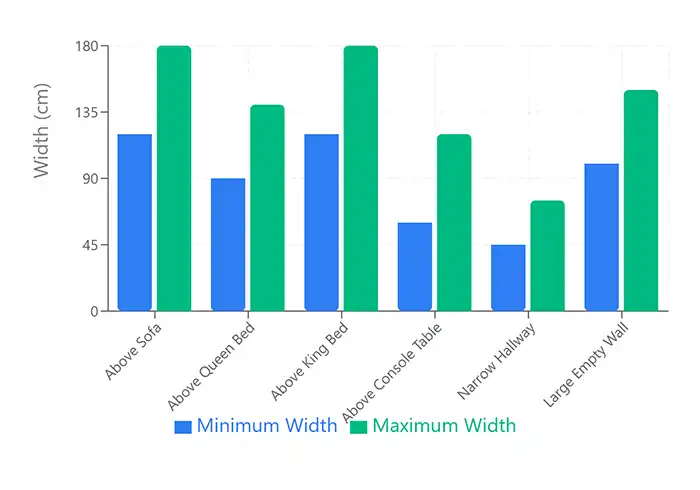
Wall Art Size Chart for Common Placements
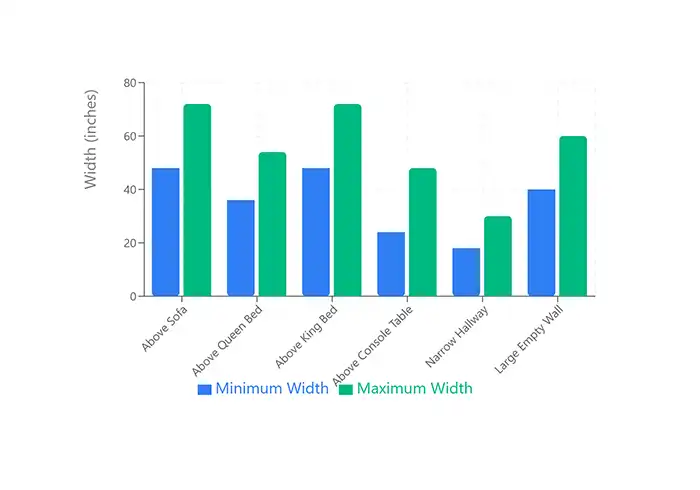
| Location | Width (inches) | Width (cm) |
| Above sofa | 48–72 | 120–180 |
| Above queen bed | 36–54 | 90–140 |
| Above king bed | 48–72 | 120–180 |
| Above console table | 24–48 | 60–120 |
| Narrow hallway | 18–30 | 45–75 |
| Large empty wall | 40×60–48×72+ | 100×150–120×180+ |
These are starting points. The calculator above gives you the exact range for your specific measurement rather than a general bracket.
Horizontal vs Vertical: Does Orientation Change the Rule?
The 60–75% width rule applies the same way regardless of orientation — but the visual result differs enough that it’s worth understanding before you buy.
Horizontal (landscape) pieces work best on wide, low walls — above a sofa, bed or console — because the width does the proportional work the rule is built around. A single horizontal piece at 60–75% of furniture width fills the wall the way the rule intends.
Vertical (portrait) pieces need a different approach. A single vertical piece rarely reaches 60% of a wide wall’s width on its own. Pairing two or three vertical pieces side by side, with their combined width falling in the 60–75% range, achieves the same proportional balance. Vertical pieces also work well in narrow spaces — hallways, beside doorways, stairwells — where there isn’t enough width for a horizontal piece to begin with.
If you’re choosing between a single horizontal piece and a multi-piece vertical arrangement for the same wall, the calculator above still applies — treat a vertical grouping as one combined width, the same way you would a gallery wall.
Height Guidelines
Standard gallery height: centre of the piece at 57 to 60 inches (145 to 152cm) from the floor — the average adult eye level when standing.
Above furniture: leave 6 to 12 inches between the top of the furniture and the bottom of the art.
Below the ceiling: leave at least 6 to 8 inches between the top of the art and the ceiling line.
High ceilings: if your ceiling is above 9 feet, you can hang slightly higher than standard — but keep the art proportional to the furniture below it rather than the ceiling height.
→ How High to Hang Pictures and Paintings: The Correct Height Formula
Above the Bed: A Closer Look
The bed wall needs its own rule because the headboard width — not just the mattress width — is what the art should relate to.
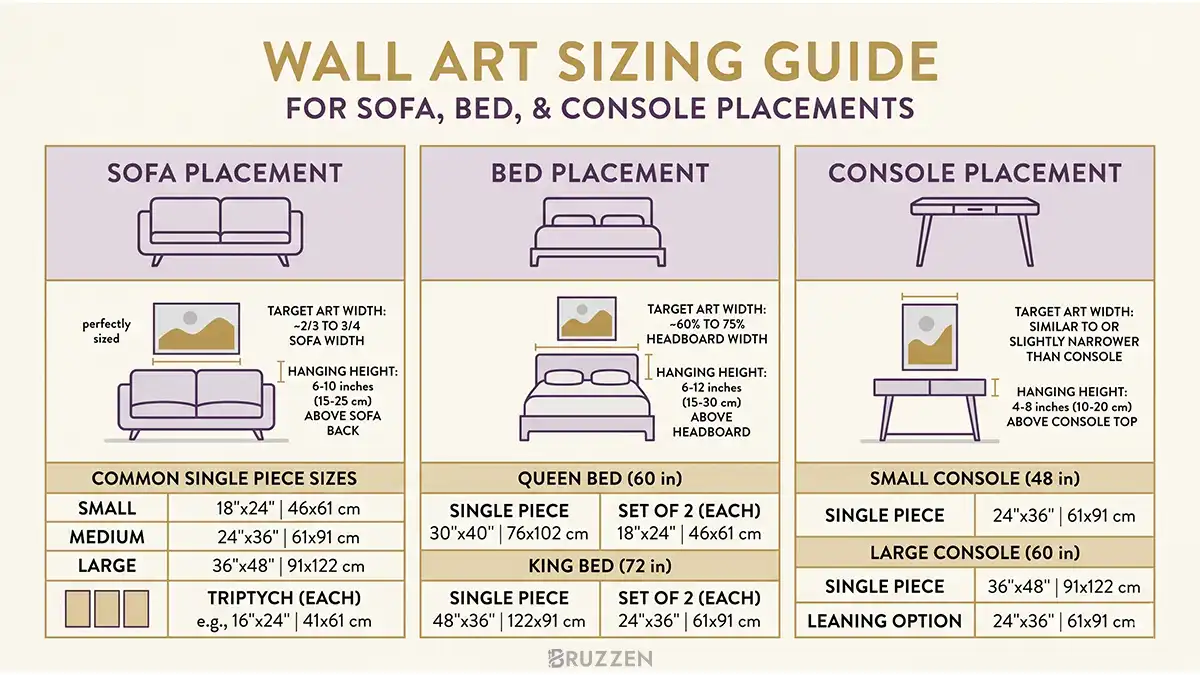
Queen bed (60 inches wide, headboard typically 62 to 66 inches): art should be 36 to 50 inches wide.

King bed (76 to 80 inches wide, headboard typically 78 to 84 inches): art should be 47 to 63 inches wide.
Height above the bed: bottom of the frame 6 to 10 inches above the top of the headboard.
Two pieces flanking the bed: each piece should be approximately one-third the width of the nightstand below it — typically 14 to 18 inches for a standard nightstand.
Gallery Wall Sizing
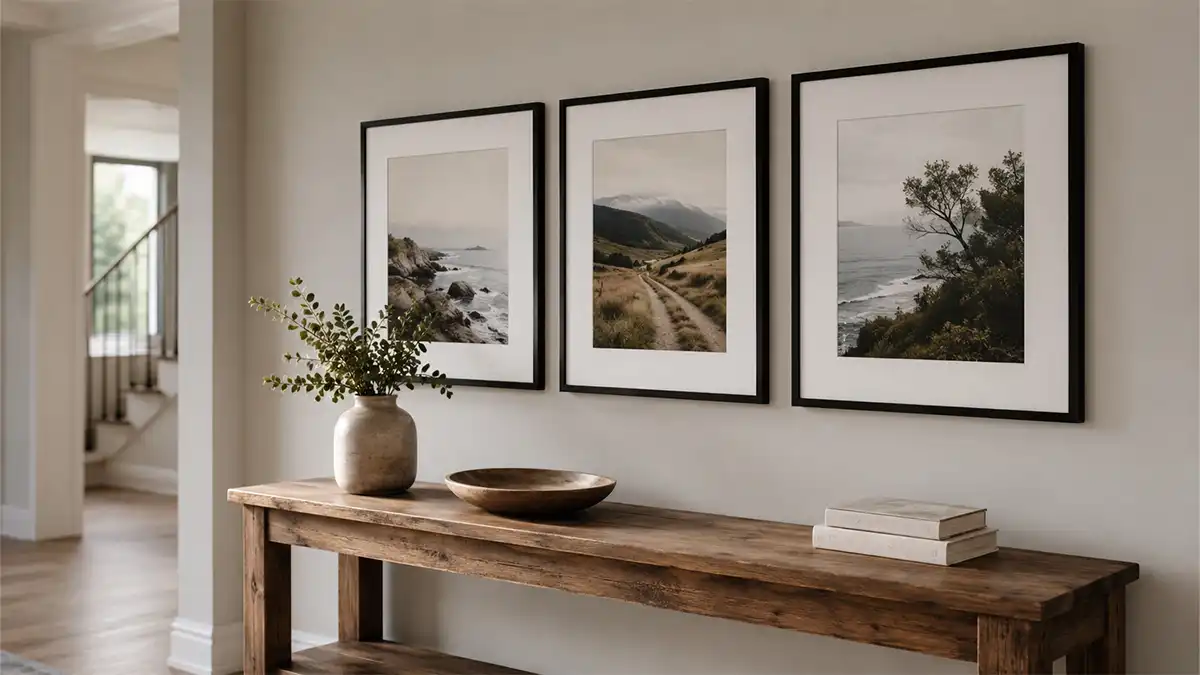
When hanging multiple pieces together, treat the whole arrangement as one piece for sizing purposes.
Plan the area first. Use painter’s tape to mark the boundary of the gallery wall before buying anything.
Apply the same 60–75% rule. The total width of the arrangement — not each individual piece — should fall in that range relative to the furniture or wall below it.
Keep consistent gaps. 2 to 4 inches between frames throughout. Wider gaps break the arrangement into separate groups rather than one composition.
Centre the whole group, not each individual piece, on the wall or above the furniture.
The calculator above includes a gallery wall mode — select it to get a per-piece size suggestion for a typical three-piece arrangement.
→ How Far Apart Should You Hang Pictures? Wall Art Spacing Guide
Canvas Art: What’s Different About Sizing
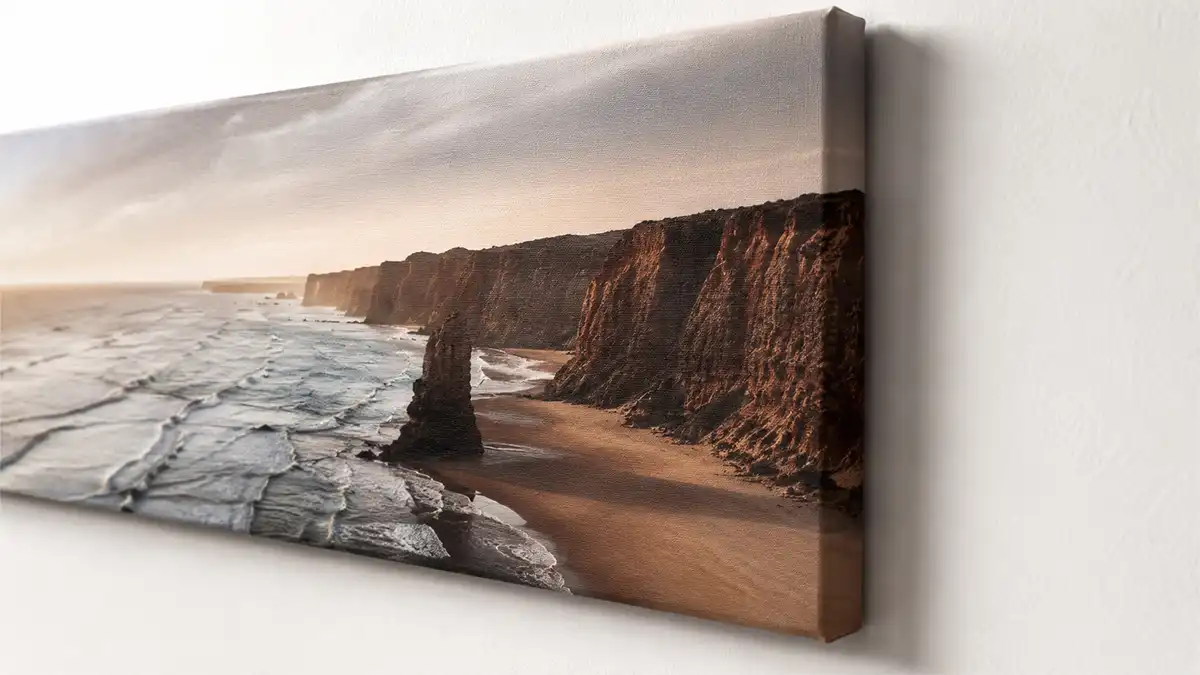
Depth matters. Canvas art is built on stretcher bars and sits 0.75 to 1.75 inches off the wall — confirm it will not collide with a light switch, door frame or adjacent piece before finalising placement.
Gallery wrap adds visual size. A gallery-wrapped canvas with the image continuing around the edges reads as larger and more modern than the same dimensions in a traditional frame, because there is no border interrupting the image.
The 60–75% rule still applies. Canvas, framed prints, metal prints and acrylic all follow the same proportional sizing — only the depth and finish change.
If you’d rather start from a standard size than calculate your own, these are the most common canvas dimensions available:
- 16 × 20 in (40 × 50 cm)
- 18 × 24 in (45 × 60 cm)
- 20 × 24 in (50 × 60 cm)
- 24 × 36 in (60 × 90 cm)
- 30 × 40 in (75 × 100 cm)
- 36 × 48 in (90 × 120 cm)
- 40 × 60 in (100 × 150 cm)
→ Canvas vs Paper Prints: Which Is Right for Your Wall?
Inches vs Centimetres
US standard: most US furniture and wall measurements are in inches. The calculator above defaults to inches but toggles to centimetres with one click.
International standard: many art retailers outside the US — and most European and UK frame manufacturers — size in centimetres. If you’re shopping across regions, always confirm which unit a specific listing uses before ordering.
Quick conversion: 1 inch = 2.54 centimetres. To convert inches to cm, multiply by 2.54. To convert cm to inches, divide by 2.54.
Room-by-Room Sizing Notes
Living room. The sofa wall is the primary focus. Apply the 60–75% rule against sofa width. A large piece makes more impact than several small ones on the same wall. → Living Room Wall Decor Ideas: How to Style Every Wall
Dining room. Centre the art over the table or buffet — not the wall. Leave clearance for any pendant lighting above the table.
Hallway. Narrow spaces need narrower art. Vertical pieces make low ceilings feel taller. Keep individual pieces under 30 inches wide in tight hallways.
Kitchen. Keep art away from direct cooking heat and moisture. Smaller pieces that don’t compete visually with cabinetry and appliances work best.
Small living room. The instinct to go smaller is almost always wrong — one large piece reads as more spacious than several small ones on the same wall. → Small Living Room Wall Decor Ideas That Make Every Inch Work
Before You Buy
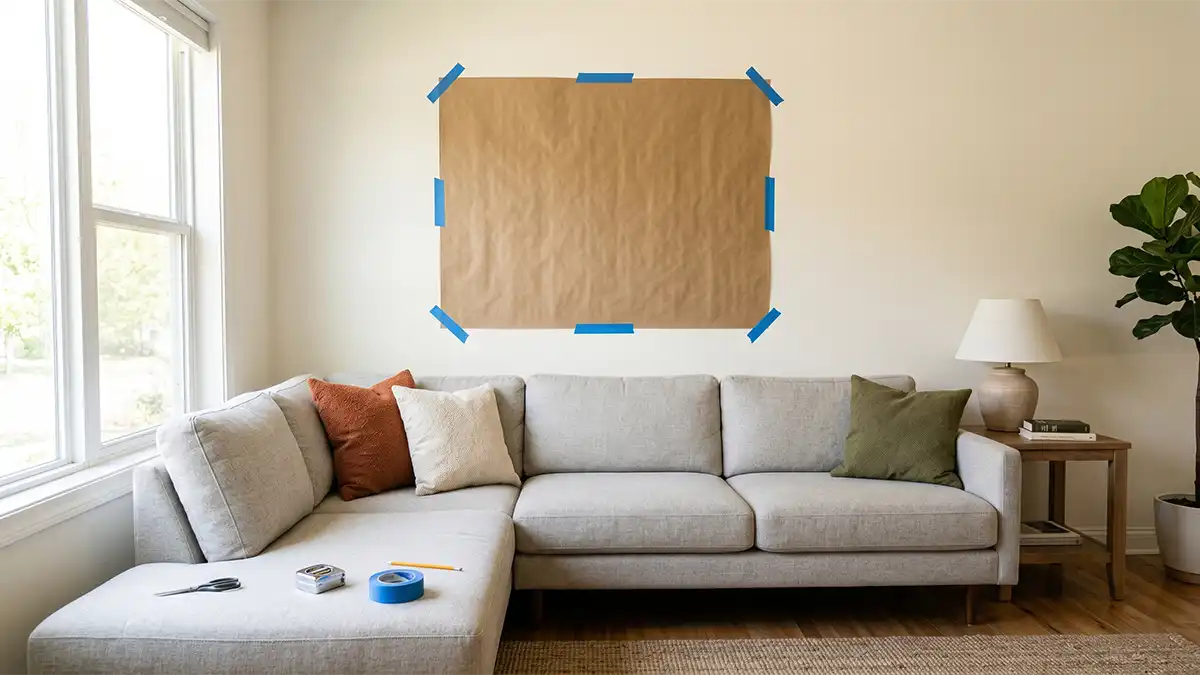
Test with paper first. Cut paper or kraft paper to your planned size. Tape it to the wall and live with it for a day before committing.
Measure the whole piece, including the frame. A frame adds 1 to 4 inches per side depending on width — always measure the complete framed dimensions, not just the artwork inside.
Account for viewing distance. Larger rooms can support larger art because the piece is viewed from further away. A piece that looks large up close can read as proportionate from across a bigger room.
Bold and simple art reads larger. Detailed, busy compositions can feel cluttered at large sizes. Clean, graphic or abstract subjects hold up better at scale.
What to Avoid
❌ Going too small. Art under 50% of the furniture width reads as lost on the wall. This is the single most common sizing mistake.
❌ Hanging too high. Standard gallery height is 57 to 60 inches centre. Hanging higher disconnects the art from the furniture below it and makes the room feel cold.
❌ Forgetting the frame. A frame adds real inches. Measure the complete framed piece before ordering, not just the print size.
❌ Skipping the paper test. Buying without a mockup test is the most common reason for returns. A few minutes with painter’s tape prevents an expensive mistake.
❌ Ignoring depth on canvas art. Gallery-wrapped canvas protrudes from the wall — check clearance from switches, door frames and adjacent furniture before finalising placement.
When to Break the 60–75% Rule
The rule is a strong default, not a law. A few situations where it’s reasonable to go outside it:
- Ceilings above 10 feet, where a larger piece balances the extra vertical space
- Unusually wide furniture, like a large sectional, where strict 60–75% sizing would require an impractically large single piece
- Gallery walls with many small pieces, where the rule applies to the total arrangement rather than each piece
- A deliberate statement wall, where drama is the goal rather than proportional balance
- Rooms with strong architectural features — an alcove, a vaulted ceiling — where the space itself dictates scale
What We See Most Often
“The single biggest sizing mistake we see is people choosing art that feels safe rather than art that fits the wall. A 24×30 canvas on an 8-foot feature wall is safe. It is also too small. Run the numbers first, then choose the piece — not the other way around. Almost everyone who uses the calculator above ends up ordering one size larger than they originally planned, and almost everyone is glad they did.” — Tricia Clarke, Founder, Bruzzen Wall Art

Shop by Size
→ Canvas Wall Art — All Sizes → Aluminium Metal Prints → Framed Canvas Prints → Acrylic Wall Art → Create a Custom Size
Frequently Asked Questions
What size wall art should I buy for above my sofa?
60 to 75% of the sofa’s width. For an 84-inch sofa, that’s 50 to 63 inches. Use the calculator above to get the exact range for your specific sofa width and see the closest ready-to-order Bruzzen size.
Is there a free wall art size calculator?
Yes — the calculator at the top of this page is free, works in both inches and centimetres, and covers sofas, beds, consoles, blank walls and gallery wall arrangements. It also matches your result to the closest standard Bruzzen size.
What size art goes above a queen bed?
36 to 50 inches wide, accounting for headboard width rather than just the mattress. The bottom of the frame should sit 6 to 10 inches above the top of the headboard.
How do I size a gallery wall?
Treat the entire arrangement as one piece. The total width of all the frames combined should fall within 60 to 75% of the furniture or wall width below it. Keep 2 to 4 inches between individual frames and centre the whole arrangement, not each piece separately.
How do I convert inches to centimetres for wall art?
Multiply inches by 2.54 to get centimetres. Divide centimetres by 2.54 to get inches. The calculator above automatically toggles between both units.
What if my art doesn’t exactly match a standard size?
A few inches outside the recommended range rarely makes a visible difference — the 60 to 75% range is a target, not a strict cutoff. If your ideal size falls well outside any standard option, a custom size is the better choice. Design a custom piece →
Does a frame change the size I should buy?
Yes. The frame adds 1 to 4 inches per side, depending on its width. Always measure and plan around the complete framed dimensions, not just the print or canvas size inside it.
What is a good size for wall art?
A good size follows the 60 to 75% rule relative to the furniture or wall space it’s filling. For most rooms, that means starting around 24×36 inches for a single piece and sizing up from there on larger walls. Use the calculator above to get an exact number for your specific space.
Does orientation (horizontal vs vertical) change how I size wall art?
The 60 to 75% width rule applies to both orientations. A single horizontal piece can usually reach the right width on its own. For vertical pieces, group two or three together so their combined width falls in the 60 to 75% range.
Related Guides
→ Living Room Wall Decor Ideas: How to Style Every Wall → Small Living Room Wall Decor Ideas That Make Every Inch Work → How High to Hang Pictures and Paintings → How Far Apart Should You Hang Pictures? → Canvas vs Paper Prints: Which Is Right for Your Wall? → Wall Art by Room: Placement and Sizing Guide
Want more wall art ideas, room styling tips and first access to new Bruzzen collections? Join the list — free.
Subscribe Free →